
Understanding Constructive Plate Boundaries: A Comprehensive Guide for WordPress
Explore the fascinating world of constructive plate boundaries, a fundamental concept in plate tectonics that shapes our planet’s surface. This article delves into what constructive plate boundaries are, how they form, and their significant impact on geological phenomena. Understanding these boundaries is crucial for anyone interested in geology, geography, or simply the dynamic nature of Earth.
What is a Constructive Plate Boundary?
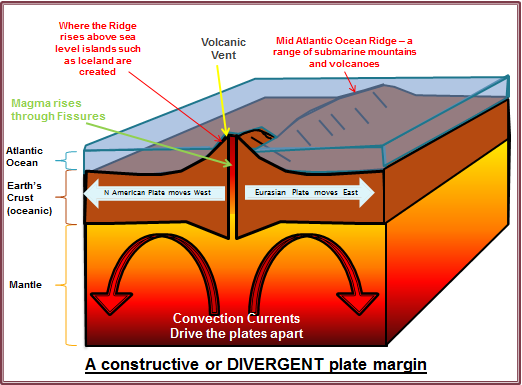
A constructive plate boundary, also known as a divergent plate boundary, is a zone where tectonic plates move away from each other. This separation allows molten rock, or magma, from the Earth’s mantle to rise to the surface, creating new crustal material. This process is the driving force behind the continuous recycling of Earth’s lithosphere.
Formation and Features of Constructive Boundaries
Constructive plate boundaries are characterized by the creation of new oceanic crust. As plates pull apart, the underlying asthenosphere, a semi-fluid layer of the mantle, experiences reduced pressure. This reduction in pressure causes the asthenosphere to partially melt, forming magma. The magma then rises through the widening rift, erupts onto the seafloor, and cools to form new igneous rock, typically basalt.
The most prominent examples of constructive plate boundaries are the mid-ocean ridges, vast underwater mountain ranges that circle the globe. The Mid-Atlantic Ridge is a prime example, where the North American and Eurasian plates are slowly drifting apart. On land, continental rifts, such as the East African Rift Valley, represent nascent constructive boundaries where continents are beginning to tear apart.
Fact: Mid-ocean ridges are the longest mountain ranges on Earth, stretching for over 40,000 miles.
Processes at Constructive Plate Boundaries
The primary process occurring at constructive plate boundaries is seafloor spreading. As new crust is generated at the ridge crest, it pushes the older crust away from the center. This constant movement is responsible for the drift of continents and the opening and closing of ocean basins over geological time.
Volcanic activity is a common feature at these boundaries, although it is typically less explosive than at convergent boundaries. The rising magma often erupts effusively, creating lava flows and underwater volcanoes. Earthquakes are also frequent, but they are generally shallow and less powerful than those associated with other types of plate boundaries.
Types of Constructive Boundaries
- Mid-Ocean Ridges: These are underwater mountain ranges where new oceanic crust is formed.
- Continental Rifts: These are divergent boundaries on land where continents are being pulled apart, potentially leading to the formation of new ocean basins.
Impact and Significance of Constructive Plate Boundaries
Constructive plate boundaries play a critical role in the Earth’s geological system. They are responsible for:
- Creating New Crust: The continuous generation of new lithosphere at mid-ocean ridges replenishes the crust that is lost at subduction zones elsewhere.
- Driving Plate Tectonics: The upwelling of hot mantle material and the spreading of the seafloor contribute to the forces that move tectonic plates.
- Forming Ocean Basins: The processes at constructive boundaries are fundamental to the opening and widening of oceans.
- Influencing Climate: Over long timescales, the configuration of continents and oceans, dictated by plate tectonics, affects ocean currents and global climate patterns.
| Feature | Description | Example |
|---|---|---|
| Seafloor Spreading | The creation and outward movement of new oceanic crust. | Mid-Atlantic Ridge |
| Volcanic Activity | Effusive eruptions of basaltic magma. | Iceland (straddling the Mid-Atlantic Ridge) |
| Earthquakes | Shallow and relatively low-magnitude seismic events. | East African Rift Valley |
Constructive Boundaries and Resources
The geological processes at constructive plate boundaries can lead to the concentration of valuable mineral deposits. Hydrothermal vents, found along mid-ocean ridges, release mineral-rich fluids that can form deposits of copper, gold, and zinc.
Did You Know? Iceland is one of the few places where a constructive plate boundary is visible above sea level, offering unique geological insights.
Frequently Asked Questions about Constructive Plate Boundaries
What is the main process that occurs at a constructive plate boundary?
The main process is seafloor spreading, where new oceanic crust is formed as tectonic plates move apart.
Are earthquakes common at constructive plate boundaries?
Yes, earthquakes are common, but they are typically shallow and less powerful compared to those at other types of plate boundaries.
Can constructive plate boundaries be found on land?
Yes, continental rift zones, such as the East African Rift Valley, are examples of constructive plate boundaries on land.
Conclusion
Constructive plate boundaries are vital engines of geological change, constantly reshaping the Earth’s surface. They are the birthplaces of new oceanic crust, driving the grand cycle of plate tectonics and influencing everything from ocean formation to the distribution of mineral resources. The ongoing dance of continents and oceans, powered by these divergent zones, is a testament to the dynamic and ever-evolving nature of our planet. Understanding these boundaries provides invaluable insights into the Earth’s past, present, and future geological landscape. Their study continues to unlock secrets about our planet’s inner workings and its profound impact on life itself.
